The system of record for AI investment decisions

Which AI investments, in what order, on what evidence?

Operient shows where AI is worth funding, what should come first and what oversight each investment needs. You get an evidence-based recommendation built on data from your own operation.

Vendor-independent We recommend what fits your operation, not a particular tool or vendor.
Why Operient

The assumptions change faster
than the plans.

Today
Investment

Most companies have started using AI to some degree. Many cannot show what it delivers. Time and budget are spent on pilots, many of which never reach production.

Ongoing
Technology

New tools, models and prices appear every month. What didn't pay off last year may today, and the other way round.

Now and 2027
Regulation

Financial firms already have to justify their technology choices (DORA). From December 2027 the EU AI Act adds requirements for high-risk systems, and Iceland follows through the EEA.

Sources: Regulation (EU) 2022/2554 (DORA); Regulation (EU) 2024/1689, as amended by Regulation (EU) 2026/1744.

Most AI investment decisions are still made in slide decks, meetings and spreadsheets. They are hard to compare, hard to defend and out of date within months. Operient keeps the assessment, the reasoning and the oversight in one place, and updates them when the assumptions change.

Inside Operient

The decision is traceable.

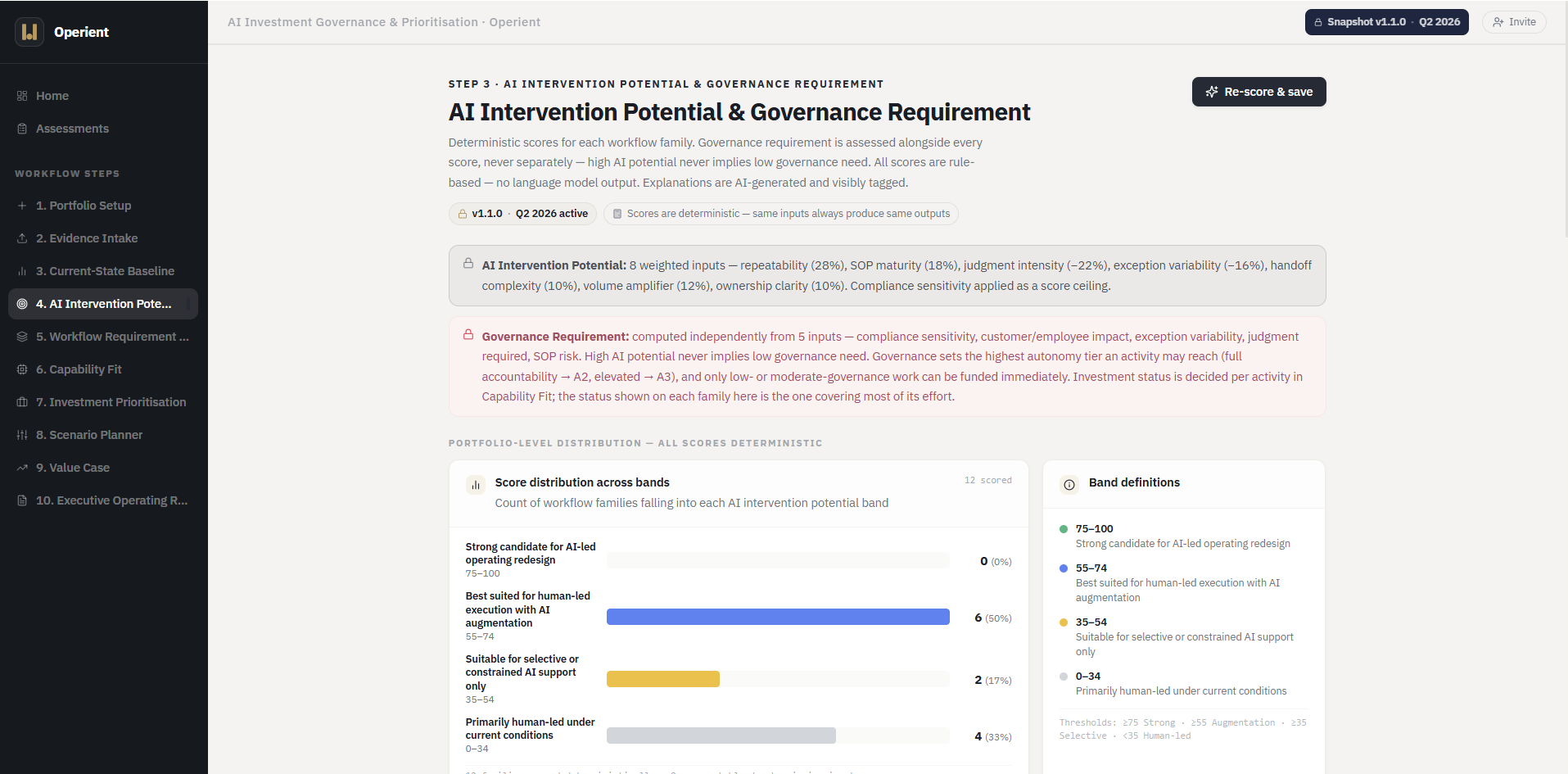
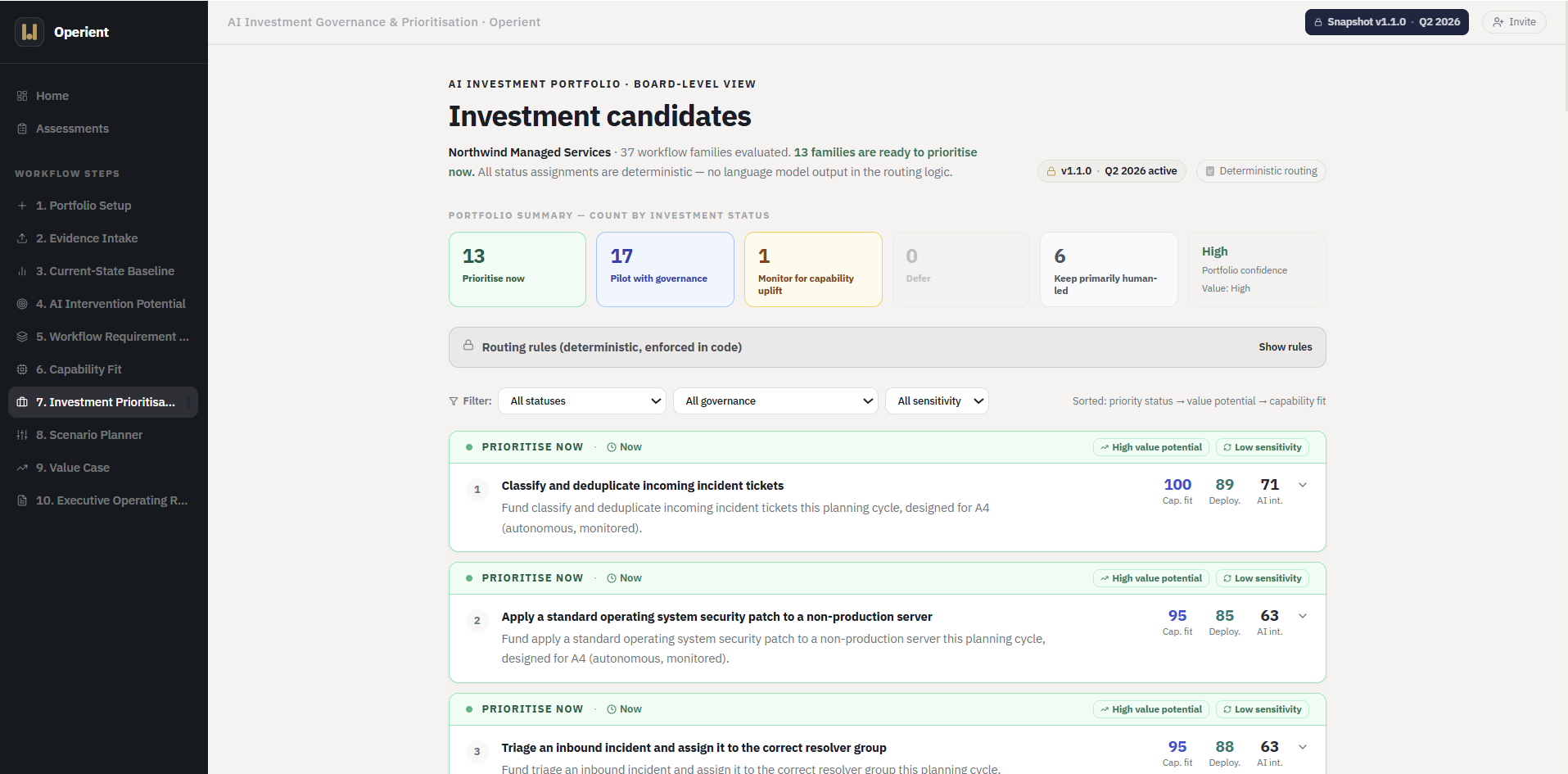
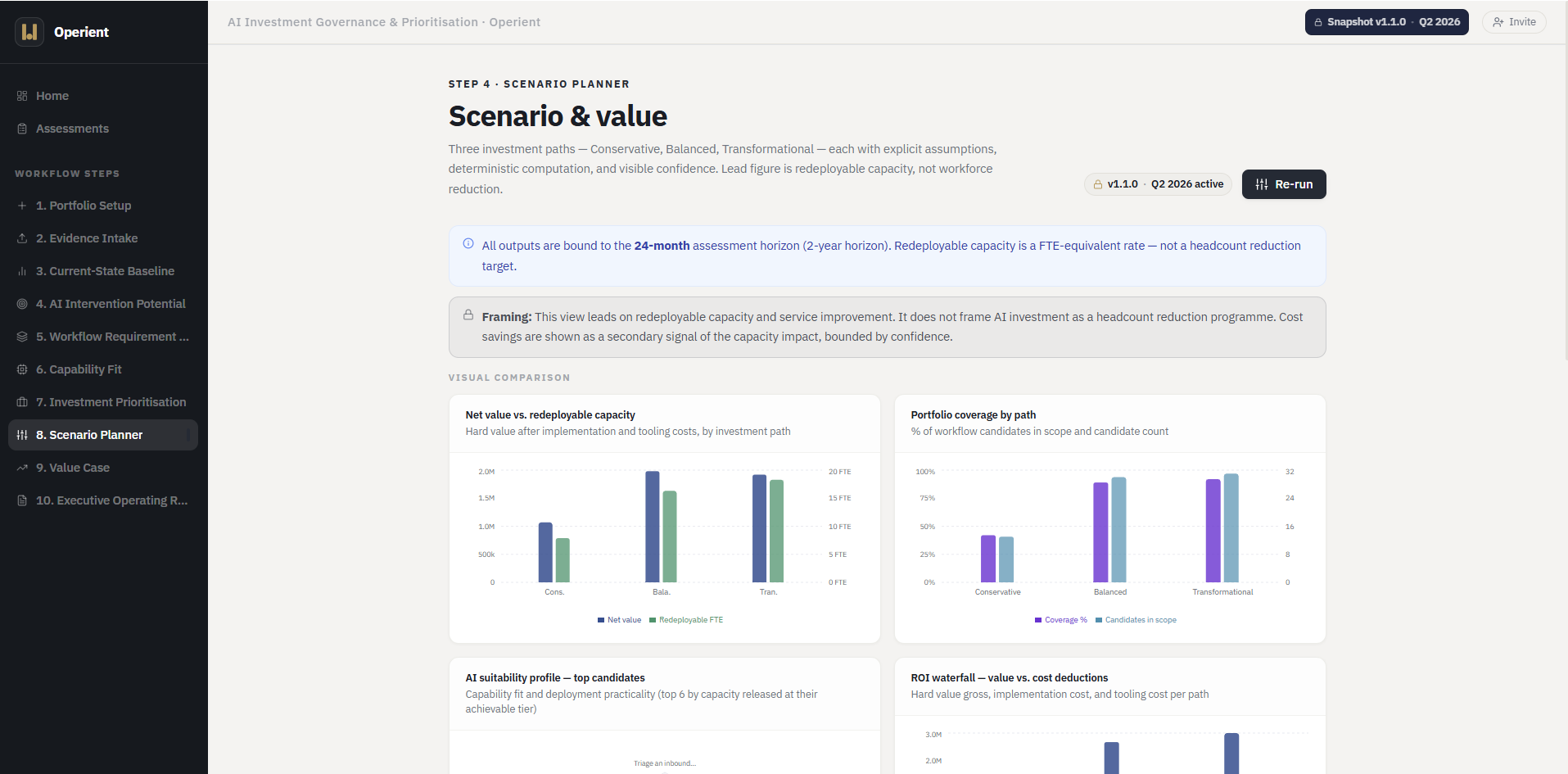
For each opportunity you see the expected value, priority, assumptions and governance requirements. That makes clear not only what to do, but why.

1 / 4

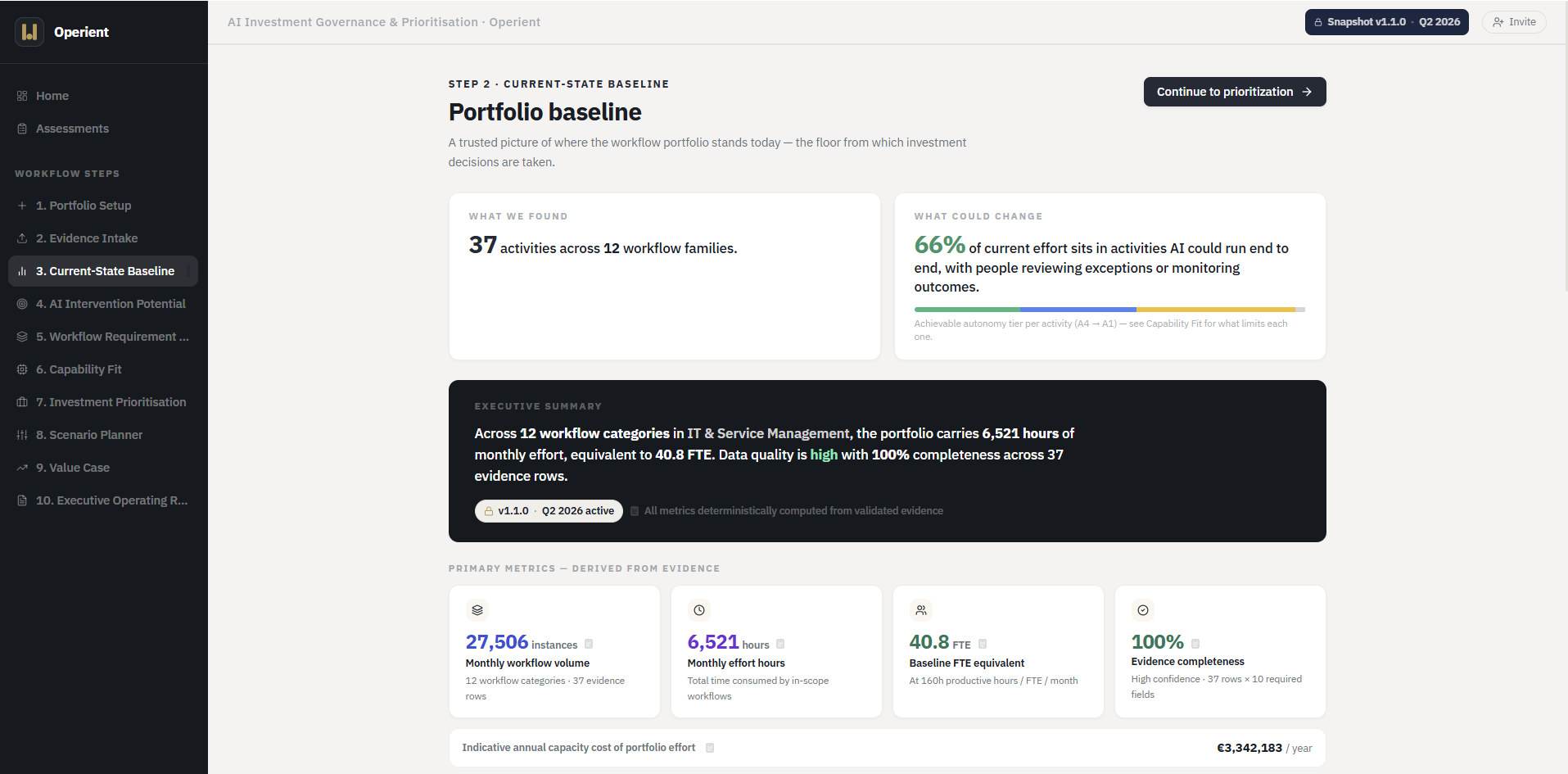
First, you record how the work is done today.

Current-State Baseline for the example organisation’s portfolio: 10 process areas, 6,521 monthly effort hours, 92% evidence completeness.
Current-State Baseline

Current state for the example company: 10 process areas, 6,521 hours of work per month, 92% data completeness.

Sample with fictional data. The company is not an Operient client.

What Operient delivers

A solid basis for the investment decision.

Operient brings data, assessment and assumptions together in one place. You get an evidence-based recommendation on what should be prioritised, what value is likely to be achieved, and which governance requirements must be met before you invest. The decision is always yours.

AI suitability

Where AI can create value, given what the operation requires and what the technology can reliably do today.

Value and assumptions

The expected value, costs, uncertainty and the assumptions the result depends on.

Governance and oversight

The controls, accountability and oversight that should be in place before moving forward.

Recommendation and review

The recommendation, the rationale behind it and when the decision should be reviewed.

The method

From your data to an evidence-based recommendation.

Operient brings two things together: your data on the workflows, and Operient's capability snapshot of what AI solutions on the market can reliably do today. The snapshot is updated as the technology changes, and every result is recorded with the version it was based on. You can re-run the assessment whenever your data, assumptions or the technology change.

See how it works →

Where Operient fits

Operient comes before implementation.

Companies have the data, tools and partners to implement AI. Operient helps you choose what to implement, in what order and on what basis.

  1. 01

    Operational data

    You provide evidence of how work runs today: volumes, handling times and exceptions.

  2. 02

    Operient: investment recommendation

    Operient assesses your data against a capability snapshot of what AI solutions can reliably do today. The recommendation shows what should come first, what value to expect and which conditions must be met.

  3. 03

    AI implementation

    You or your partners implement the new AI solution and connect it to your systems. Operient takes no part in the implementation.

  4. 04

    Run and oversight

    You run the solution and monitor it. When the assumptions or the technology change, it goes back into Operient for a new assessment.

Operient does not replace process intelligence, automation platforms or AI monitoring tools. It shows which opportunities should go to them, and why.

What Operient is — and what it is not
It is
A step before the build

It sits between “where should we use AI?” and the tools that build and run things.

Evidence-led

It reasons from what you already know about how your processes run today.

Consistent

The same inputs give the same answer — today, next year, and in front of a regulator.

Re-run, not re-written

When capabilities change, the decision is re-scored and the prior one kept as the record.

It is not
An automation platform

We build no agents, bots or automations. We decide which ones are worth building.

Process mining

We take your process evidence as input rather than discovering it.

A rival to the platforms you run

We sit upstream and say what to do with them, and in which order.

A consulting report

A report ages from the day it lands. An assessment is re-scored against the world as it now is.

Who it's for

Leaders and teams who make decisions on AI.

The process areas the scoring is built for

Finance operations

  • Invoice exception handling
  • Accounts payable & supplier invoicing
  • Expense reimbursement
  • Regulatory & tax reporting

Customer service

  • Service request triage
  • Case routing & escalation
  • Customer onboarding
  • Refund & complaint handling

IT service management

  • Incident triage & routing
  • Change advisory
  • CMDB reconciliation
  • Access provisioning

HR service delivery

  • Employee onboarding & offboarding
  • HR case management
  • Policy Q&A
  • Benefits administration

Supply chain & order handling

  • Supplier onboarding
  • Purchase order exceptions
  • Cold-chain excursion handling

Back-office & document ops

  • Contract review
  • Claims & eligibility processing
  • Data entry & reconciliation
  • Document indexing
Key advantages

An assessment that stands up to scrutiny.

One standard for every opportunity

Every opportunity is scored against the same criteria and the same capability snapshot, so priorities rest on evidence rather than vendor pitches or internal pressure. Scores are calculated, not generated by a language model.

Traceable for boards and regulators

The data, assumptions and capability snapshot version are recorded with every recommendation. When the board, auditors or a regulator ask how a decision was made, the answer is ready.

The knowledge stays with you

After the first assessment, your own people take over: they add process areas and update earlier results in Operient. The method and the history behind each decision stay inside the company.

The Operient team

We take you through your first process area.

Your people learn the method on your own data and can carry on in Operient themselves.

Jóhanna Ríkarðsdóttir Færseth
Co-founder & CEO

Jóhanna Ríkarðsdóttir Færseth

Designed and developed Operient from the ground up, and works through the first process area with each customer. Close to twenty years in finance and technology, including responsibility for running and developing large enterprise platforms. Specialist in information security management and governance (ISO 27001).

Óðinn Thor Harðarson
Co-founder & CTO

Óðinn Thor Harðarson

Responsible for Operient's technical architecture and the capability snapshot, so the recommendations reflect what the technology can actually do. Updates the snapshot as the technology changes. More than ten years in IT, six of them leading enterprise systems and data architecture.

More about us →

Fair questions

Frequently asked questions

Answers to the questions we hear most often.

If yours isn't here, get in touch.
Isn't this just a spreadsheet?

No. A spreadsheet holds numbers, not a method. Everyone who fills it in scores differently, formulas break when rows are added, and nobody knows which version is the right one. It knows nothing about what AI can do today, and governance requirements are only included if someone remembers them. Operient scores every opportunity against the same rules and the same capability snapshot, and records each result with its assumptions. Eighteen months later you can show what you knew, what you assumed and what AI could do on the day the decision was made. A spreadsheet can't do that.

How is Operient different from hiring a consultancy?

A consulting engagement delivers a report that describes the situation on the day it was written. When the technology, rules or assumptions change, which often happens within months, you need a new engagement. The rationale behind the recommendations often leaves with the consultants when the project ends. In Operient the results stay in use: every opportunity is scored against the same criteria, every decision is recorded with its rationale, and your team updates it themselves. Consultants can also work with you in Operient, and then the result stays with you.

We've already started implementing AI. Is it too late to use Operient?

No. Most organisations already use AI to some extent. Work in progress is assessed like anything else: sometimes the assessment confirms the decision, sometimes it gives a recorded reason to stop. Better to stop with reasons than to let a project fade out.

What counts as a process area?

A process area is one bounded area of work owned by one function, such as invoice handling, service requests or contract management. It usually contains several workflows, for example invoice data capture, exception handling and supplier queries. Each workflow is assessed as a separate opportunity. You don't need a breakdown in advance: we do it with you in the first session.

Do you need access to our systems or data?

No. You send us an extract, for example from your ERP or service desk, with volumes, handling times and exceptions. Nothing is installed on your side and no personal data is needed. Direct connections to your systems will be an option later.

Where is our data, and what happens when AI changes?

We confirm in writing where your data is hosted and processed before you send anything. When AI capability changes, we update our view in a new version, and earlier decisions keep the version they were based on. Nothing changes without you seeing it.

Do you recommend vendors or implementation partners?

No. Operient recommends which opportunities to prioritise and on what basis. Who carries out the implementation is the customer's decision. Operient's founders are also partners in the consultancy Kritavi, but Operient never recommends a specific provider, and every result rests on the same method, whoever takes on the work.

First assessment

A reasoned recommendation in a few hours.

Choose one process area. We run the assessment with you, and the board gets a clear basis for its decision.

€6,500

Fixed price excl. VAT · All included · Founding price until 31 March 2027
No subscription or commitment to continue

  • ScopeOne process area of your choice.
  • What you get
    • A clear recommendation on whether to invest, with the reasoning behind it.
    • An executive report ready for the board meeting.
    • 12 months' access to the Operient platform, with reassessment.
  • Your time2–3 hours for the initial assessment and onboarding.
  • What you provideData you already have. No system integration required, and no personal data. Direct integrations are possible if you allow them.
Operient

Independent assessment of AI investments.

Operient ehf.

Kt.: 430222-1710

Contact

info@operient.is
+354 649 80 44